
-
Addressing Prescription Inequities: A Q&A with Laura Happe
A novel approach offers a practical way to identify, measure, and close disparities in access to life-saving treatments.
Inequitable access to medications could disproportionately drive worse outcomes for some patients. However, few tools exist to holistically assess the interplay between access to medications and disparate health care outcomes across race, ethnicity, gender, or socioeconomic factors. A systemic approach could help providers, payers, and regulators understand that interplay, which could then lead to improvements in patient health outcomes.
In this Q&A, Vice President Ishita Rajani discusses a novel framework that could be used to assess health care disparities with Analysis Group affiliate Professor Laura Happe.

Laura Happe: Clinical Professor and Director, Online M.S. Program in Pharmaceutical Outcomes and Policy, University of Florida College of Pharmacy
Professor Happe is a licensed pharmacist, academic, and former senior health insurance executive with health care, pharmaceutical research, and managed care expertise. She is widely published and has contributed to literature on pharmacoequity, which is a health system and policy goal of ensuring equitable access to high-quality medications. As a coauthor of “Pharmacoequity measurement framework: A tool to reduce health disparities”1 (published in the Journal of Managed Care & Specialty Pharmacy), Professor Happe helped debut a framework to evaluate and track progress toward improving pharmaceutical access.
In this conversation, Professor Happe explained the concept of pharmacoequity, described the framework that she co-developed, and outlined potential applications of that framework.
What drives unequal access to medications?
As a pharmacist focused on the health outcomes of populations, my goal is to ensure that all patients have access to their medications. That’s why it is so frustrating to see different patterns in prescribing, distribution, and uptake across patient populations.
Factors that could contribute to disparities in medication use and access between subgroups of patients include insurance coverage, provider knowledge, out-of-pocket prescription costs, and differential rates of clinical trial participation. Additionally, socioeconomic factors, such as transportation, housing insecurity, food insecurity, and systemic racism, can affect certain patients’ access to the care that they need at the time that they need it.
In your research, what have you seen that could help reduce those inequities?
Before we jump to big questions involving the resolution of differences in access to and use of medications due to social determinants of health, for example, we should take care to state that the factors that we just discussed are often in play simultaneously.
So, to address disparities in medication use or access, we should first look at how the many factors affecting such use or access interact. Patients experience unique and complicated journeys when accessing medications, beginning with a recognized need for treatment and hopefully culminating in a prescription that they can maintain. But along the way, there may be differences in patient journeys that can lead to disparate care patterns, or pharmaco-inequities.
Reducing those inequities requires nuanced review of the twists and turns of patient journeys and the factors that can contribute to disruptions in receiving high-quality medications.
How would you describe pharmacoequity, and what is your framework for assessing it?
Pharmacoequity, a term coined by my collaborator Dr. Utibe Essein,2 is a health system and policy goal of reducing health care disparities by ensuring equitable access to medications for all patients, regardless of their race, ethnicity, or resources.
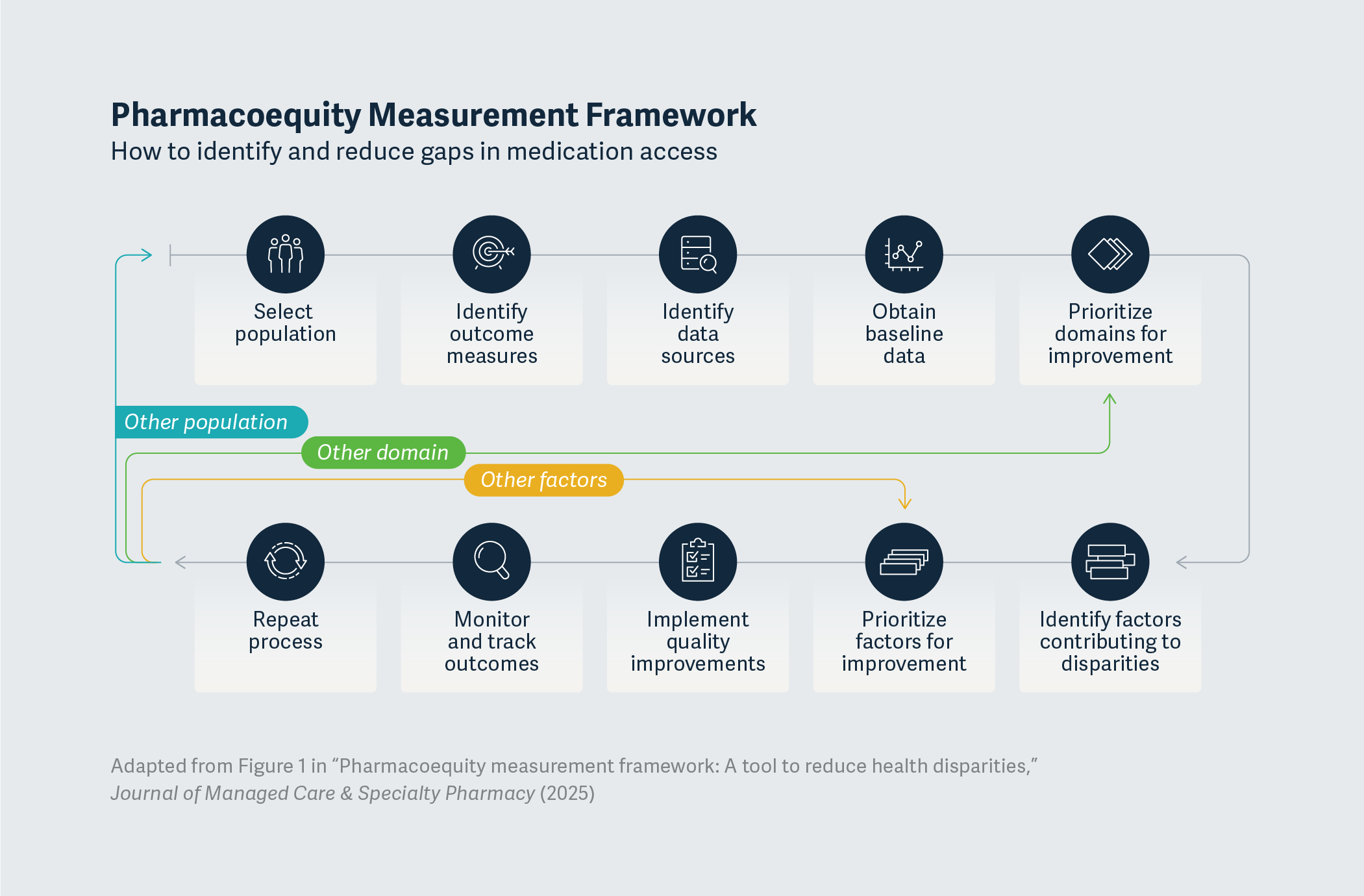
Our framework is a blueprint for health systems, health plans, and other population health stakeholders to identify gaps in pharmacoequity and assess their efforts to close them. There are five key domains along the patient medication use journey in which pharmacoequity can be measured and interventions can be targeted. Those domains are accessing health care services, obtaining prescriptions, filling prescriptions, adhering to prescription guidelines, and medication monitoring.

Ishita Rajani: Vice President, Analysis Group
And how do you quantify differences between patient experiences for each of those domains?
First, we identify relevant outcome measures for a given health condition, across selected medication use domains. Then we collect information from electronic medical records (EMRs) or claims databases to determine if disparities exist in the population that we define as including patients who have experienced those outcomes.
From there, we select the domain with the greatest disparity and priority, implement an intervention, and measure the impact of that intervention. If we move the needle on the identified disparity, we repeat the process to assess other disparities or health conditions. Since this cycle may be repeated with learnings implemented ad infinitum, findings can help health systems understand specific pharmacoequity questions, which may lead to the resolution of inequities within those systems.
Could you walk us through an example?
Absolutely. Let’s take racial disparities in the use of anti-obesity medications as an example. We’d start by identifying relevant outcome measures for each medication use domain, such as frequency of primary care provider visits (to assess the access to health care providers domain), or prescribing rates (to assess the primary adherence domain).
Upon establishing baseline metrics, we may uncover a disparity in prescribing rates across racial groups, for example, and target that as an area for improvement. In that case, we’d implement an intervention such as EMR alerts for eligible patients and then measure the impact of that intervention by reassessing racial disparities in prescribing rates.
Finally, depending on the organizational goals and resources, we’d repeat the process to assess any disparities in anti-obesity medication use that we uncovered, or expand our analysis to other health conditions.
“Our framework is a blueprint for health systems, health plans, and other population health stakeholders to identify gaps in pharmacoequity and assess their efforts to close them.”– Laura Happe
Are organizations practically responding to pharmacoequity concerns today?
Several prominent health care systems are pursuing pharmacoequity efforts, including Boston Medical Center and Johns Hopkins Medicine. These organizations are leveraging the ideas that we’ve talked about to streamline medication access for high-risk patients through formulary changes, for example.3
Also worth highlighting is the research that Analysis Group has conducted on health care disparities. Two of those studies – one on racial disparities in receiving treatment intensification among patients with prostate cancer and another on disparities in the use of tools to diagnose Alzheimer’s disease – map clearly to the pharmacoequity framework that I described.
How might your framework be leveraged by those responsible for health insurance plans or patient care going forward?
Our framework was created to be adaptable so that organizations can monitor and track the progress of their interventions toward their pharmacoequity aims across prescriptions, diseases, and patient populations.
We envision that evidence generated from the use of the framework could be leveraged to create “pharmacoequity scorecards” that can be adapted to specific medications, conditions, and patient journeys. This approach can support more patient-centered care and provide a scalable way to identify, track, and close gaps in medication access. ■
Endnotes
- “Pharmacoequity measurement framework: A tool to reduce health disparities,” Journal of Managed Care & Specialty Pharmacy (2025), coauthored by Pranav M. Patel (Academy of Managed Care Pharmacy), Utibe R. Essien (David Geffen School of Medicine, University of California), and Laura Happe (University of Florida, College of Pharmacy).
- “A Policy Prescription for Reducing Health Disparities—Achieving Pharmacoequity,” JAMA (2021), coauthored by Utibe R. Essien (University of Pittsburgh School of Medicine), Stacie B. Dusetzina (Vanderbilt University School of Medicine), and Walid F. Gellad (University of Pittsburgh School of Medicine).
- “Pharmacist-Driven SMART Formulary Improves Pharmacoequity,” American Journal of Managed Care (2025), coauthored by Erin Van Meter, Caitlin Dowd-Green, Shay Roth, Robert Green, Amanda Bertram, and Rosalyn Stewart (Johns Hopkins Health System).

AG Feature
This feature was published in July 2026.