
-
Assessing the Blocking Patent Defense in Pharmaceutical Litigation: A Q&A with Anna Gumen and Andrea Hugill
As part of nonobviousness challenges in pharmaceutical patent litigation, factfinders often evaluate whether the success of a drug reflects the inventiveness of the asserted patent or whether that success is due to the existence of a blocking patent that precluded entry.
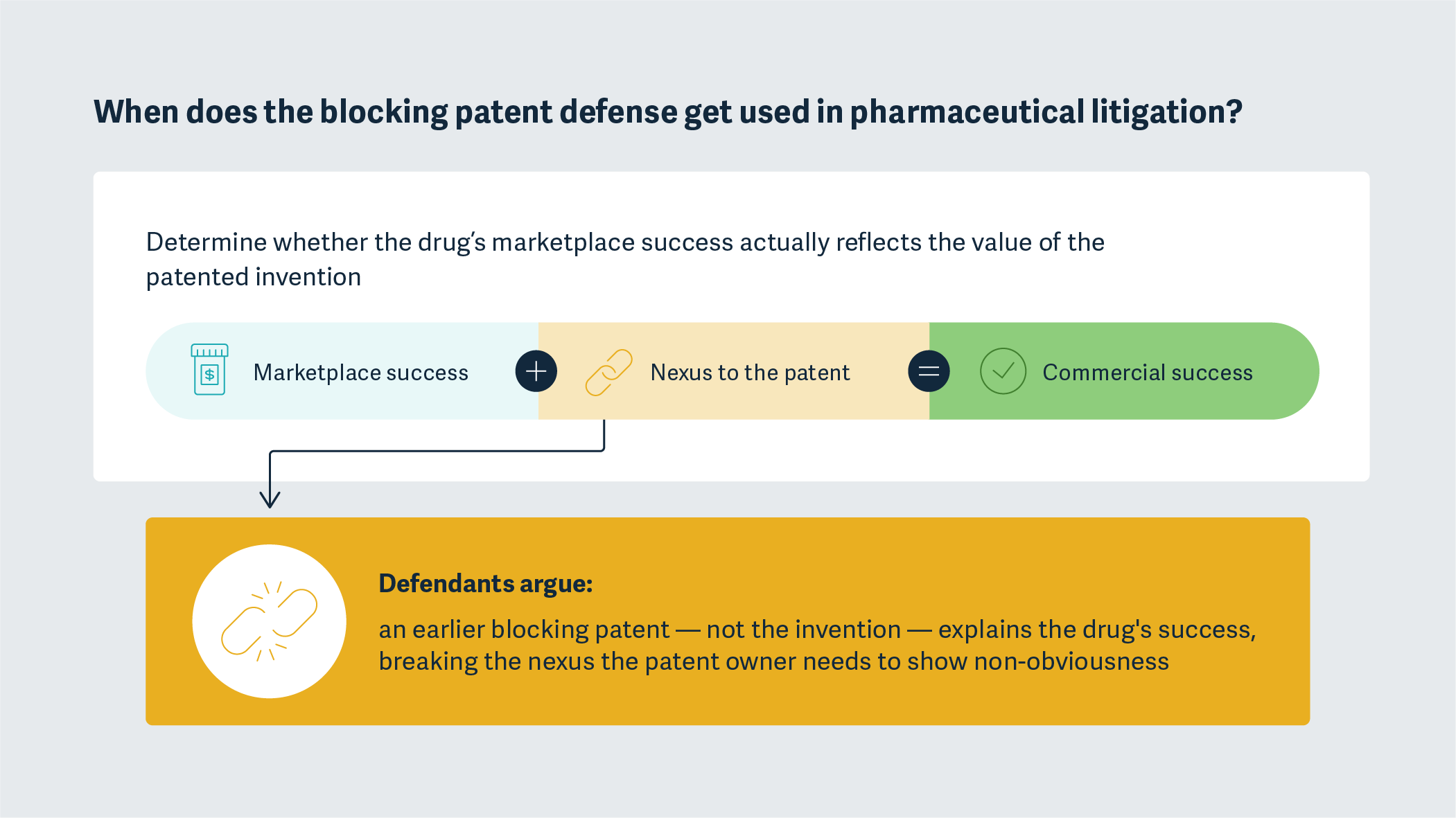
In patent litigation, evidence of a patented product’s marketplace success can support a patent owner’s argument that the invention was not obvious at the time of invention.1 But marketplace success does not speak for itself: To be probative, it must be connected – or have a nexus – to the claimed invention. That nexus question can be central to pharmaceutical cases where the patent’s validity is challenged. The success of a drug may be reflective of many forces at once, and litigants may seek to challenge the nexus and the significance of its success through the blocking patent defense. Under this defense, patent challengers argue that the product’s success can be explained by the existence of an earlier patent that deterred others from pursuing the same invention rather than the unique qualities of the invention described in the patent-at-issue.
Use of and acceptance of the blocking defense has grown at the Federal Circuit in recent years, but often the evidence supporting the defense is thin, or it lacks rigor. Addressing the patent blocking defense requires a fact-specific and evidence-based understanding of whether the claimed blocking patent actually changed what potential and actual competitors did in the real world. In short, while an earlier patent may deter some activity, it may not practically foreclose every path to innovation. In pharmaceutical cases, the existence of an earlier patent might have had limited impact on the incentives and decisions of competing drugmakers due to lengthy research and development timelines.
To examine how courts have considered the blocking patent defense and provide an economic framework to assess its applications, Analysis Group Managing Principal John Jarosz and Vice Presidents Anna Gumen and Andrea Hugill published “Mending the Fence: Commercial Success & The Blocking Patent Defense in Pharmaceutical Litigation” in the AIPLA Quarterly Journal.2
In this Q&A, Drs. Hugill and Gumen discuss why the assumptions underlying a blocking patent defense may be less solid than they initially appear, and how economic analysis can help courts and litigants assess whether earlier patents meaningfully affected follow-on innovation, competition, and marketplace success.
What challenges can arise in showing that a pharmaceutical product’s success is attributable to its unique, patented qualities?

Andrea Hugill: Vice President, Analysis Group
Dr. Hugill: Establishing a causal nexus can be especially challenging in pharmaceutical cases because a drug’s success may reflect many factors beyond the claimed invention itself. These may include payer coverage, pricing, marketing, brand recognition, regulatory exclusivity, and the competitive landscape at launch.
Dr. Gumen: Timing adds another layer of complexity. The date of invention, patenting, regulatory approval, and commercialization may be separated by many years because of the time required for clinical development and FDA approval. Many factors impact the likely and actual success of a product.
Dr. Hugill: That’s right, and courts have said that the asserted patent does not need to be the sole reason for the success of the product – it just needs to be an important one.
Dr. Gumen: For these reasons, the central question is not simply whether the drug was successful. It is whether a portion of that success can fairly be attributed to the claimed invention, rather than to other marketplace, regulatory, or competitive factors.
How have courts evaluated assertions of the blocking patent defense in pharmaceutical litigation?
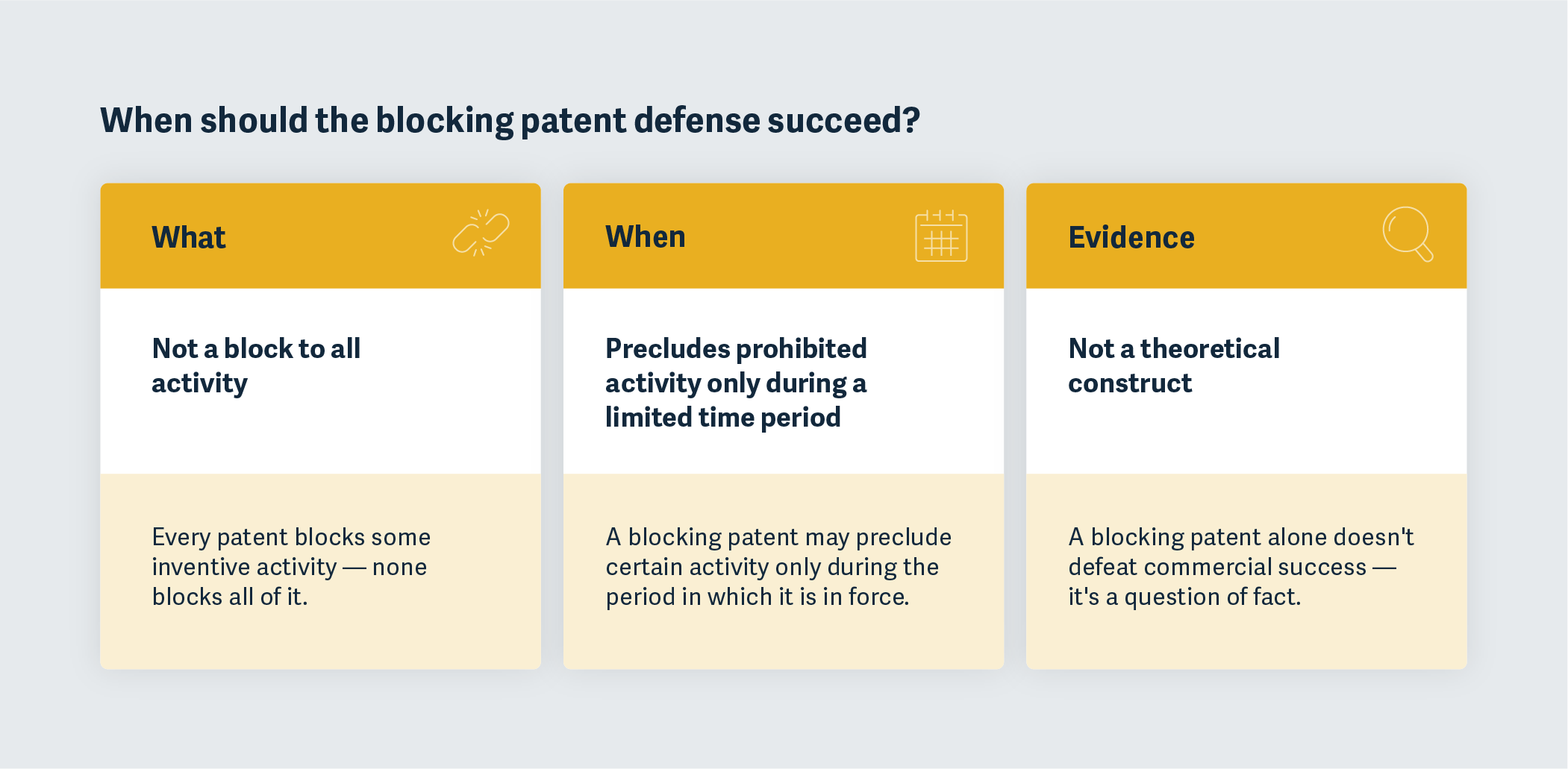
Dr. Gumen: Many courts, including the Court of Appeals for the Federal Circuit, have recognized that the blocking patent defense can matter, but they also have made clear that the existence of earlier claimed blocking patents is not dispositive. Not all earlier patents are indeed blocking.
Dr. Hugill: In Acorda Therapeutics, Inc. V. Roxane Laboratories, Inc., the Federal Circuit described a blocking patent as one that could prevent others from practicing a later invention without infringing an earlier patent.3 The court also recognized that such a patent could deter firms from investing the time and resources needed to develop or commercialize a later invention.

Anna Gumen: Vice President, Analysis Group
Dr. Gumen: But that court emphasized the necessity of a fact-specific inquiry into the actual incentives facing potential innovators – considerations such as development costs, market opportunity, licensing options, patent challenges, and alternative investments – when assessing assertions of the blocking patent defense.
Has the blocking patent defense been invoked frequently in that context?
Dr. Hugill: Increasingly, and it often succeeds.
Dr. Gumen: From 2005 to 2013, the Federal Circuit issued opinions in four pharmaceutical cases involving the defense, finding a blocking patent in two instances.
Dr. Hugill: And in the ensuing decade, the same court decided eleven such cases, finding a block in seven.
When and why does the blocking patent defense succeed?
Dr. Gumen: The defense begins with a challenge to the claimed nexus between a product’s success and the at-issue patent. From there, the argument is that the product succeeded because an earlier patent precluded others from inventing and launching a commercially successful product. A winning blocking patent defense necessarily undermines the understanding that the claimed invention drove demand for the product.
Dr. Hugill: But the existence of an earlier patent doesn’t end the inquiry; the defense often rests on assumptions about what other firms would have or could have done in the absence of that patent.
Dr. Gumen: To test those assumptions, courts may ask for evidence of actual incentives, costs, risks, alternatives, and market opportunities impacted by the existence of the allegedly blocking patent.
Dr. Hugill: And this is where economic evidence can play an important role, by helping courts assess those issues, including the costs, risks, competitive conditions, and differences in value associated with pursuing the development of a given drug.
Could you be more specific about how economic evidence may help factfinders assessing assertions of the blocking patent defense?
Dr. Hugill: A key question in such an inquiry is whether there exists a causal nexus for commercial success. Did an earlier patent meaningfully deter innovation or entry? If so, did it do that in a way that weakens the connection between the at-issue patent and the product’s marketplace success?
Dr. Gumen: The existence or absence of a causal nexus needs to be tested, not assumed. The patent owner must show that the product’s marketplace success is tied to the features or benefits of the related patented technology, rather than unrelated factors.
Dr. Hugill: This distinction is especially important in pharmaceutical cases: a drug may perform well for many reasons, including marketing, brand recognition, reimbursement conditions, physician familiarity, regulatory exclusivity, unmet medical need, or the absence of close substitutes.
Dr. Gumen: And economists are well-positioned to deliver rigorous evidence on each of those factors.
Is there an economic framework that could be used to assess assertions of the blocking patent defense?
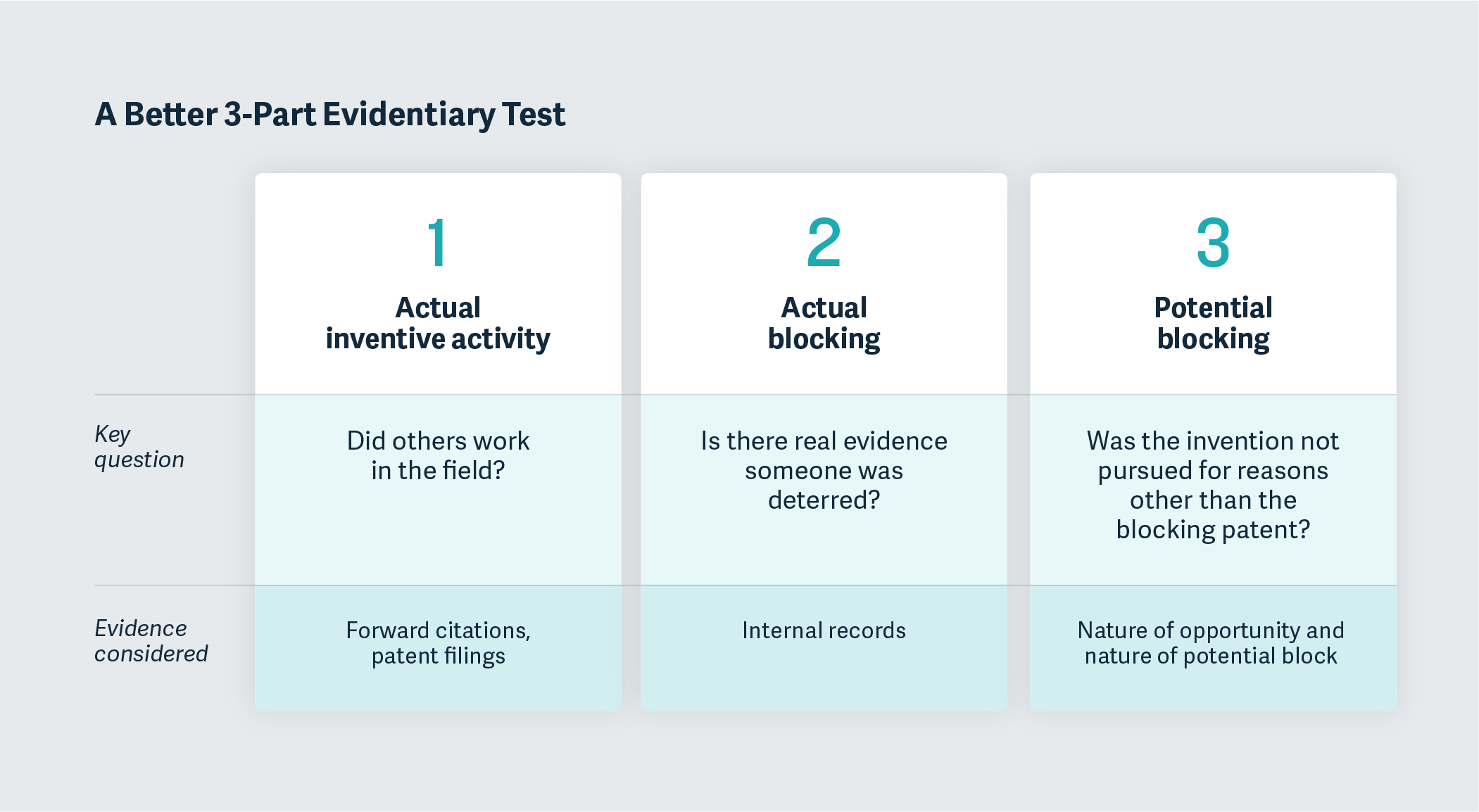
Dr. Gumen: When a blocking patent is asserted, the corresponding inquiry should be evidence-based. We think a useful framework starts by identifying whether others plausibly could have pursued the at-issue invention, assessing the incentives and roadblocks that those firms faced at the relevant time.
Dr. Hugill: From there, the framework can be used to evaluate the expected benefits and costs of pursuing a follow-on invention. An economic expert could then consider factors such as the marketplace opportunity, development costs, probability of technical and regulatory success, and time required to reach commercialization. Those factors may have discouraged entry, as opposed to an asserted blocking patent.
Dr. Gumen: Such an expert might also consider the earlier claimed blocking patent itself, including its apparent strength, claim scope, remaining life, and whether a license was available. Those characteristics can affect whether the patent was viewed as a true barrier, a manageable risk, or something in between.
Dr. Hugill: In practice, those questions can be evaluated using evidence such as R&D activity, clinical trials, patent filings, licensing discussions, internal business documents, marketplace forecasts, and observed entry or non-entry. That empirical evidence can help inform whether the alleged blocking patent affected real-world behavior.
Dr. Gumen: The goal is to compare what potential innovators likely would have done – absent from the earlier patent – with what they did in its presence. That comparison can help courts assess whether the earlier patent likely changed the behavior of potential innovators, and if so, how much.
And how might this framework be applied in practice?
Dr. Gumen: Whether an alleged blocking patent actually affected real-world activities will almost always depend on the facts. Economic analysis can help move the blocking patent inquiry from abstract theory to real-world evidence.
Dr. Hugill: Rather than assuming that an earlier patent necessarily did – or did not – deter follow-on innovation, economic experts can examine what potential innovators were likely to do given the costs, risks, incentives, and expected rewards they faced.
Dr. Gumen: That may include assessing the scope of an earlier patent, available design-arounds, licensing options, regulatory or development hurdles, expected marketplace opportunity, and how similarly situated firms behaved in practice.
Dr. Hugill: Ultimately, this evidence can help courts and prospective litigants evaluate whether commercial success is better explained by the non-obviousness of the claimed invention, the deterrent effect of an earlier patent, or other market, competitive, and regulatory factors.
Dr. Gumen: Yes, and because that assessment is highly fact-specific, economic analysis can help organize evidence around the questions that matter most, including what could have happened in the real world under the circumstances. ■
Endnotes
- Graham v. John Deere Co., 383 US 1 (1966).
- “Mending the Fence: Commercial Success & The Blocking Patent Defense in Pharmaceutical Litigation,” AIPLA Quarterly Journal, coauthored by John Jarosz, Andrea Hugill, Anna Gumen, and Michael Chapman.
- Acorda Therapeutics, Inc. v. Roxane Laboratories, Inc., 903 F.3d 1310 (Fed. Cir. 2018).

AG Feature
This feature was published in August 2026.