
-
Competition and the AI Stack: A Q&A with Catherine Tucker
What are the components of the AI stack, and how is the stack changing the competition landscape?
Just as the capabilities of AI have continued to evolve, so has our understanding of it. Only a few years ago, AI was widely considered to be a single technology. Today we know better: AI is a stack – a collection of hardware, software, and frameworks. In a conversation with Managing Principal Aaron Yeater, MIT Sloan School of Management Professor Catherine Tucker examines the different layers of the AI stack and how it’s already changing the competition space.
Let’s start with the term “AI stack.” What does it mean, and what are the layers that make up this stack?

Catherine E. Tucker: Sloan Distinguished Professor of Management Science and Professor of Marketing, MIT Sloan School of Management
The AI stack is a very new concept. If we go back in time a few years, we had the idea it was a homogeneous technology. Now we have come to see it as a collection of components.
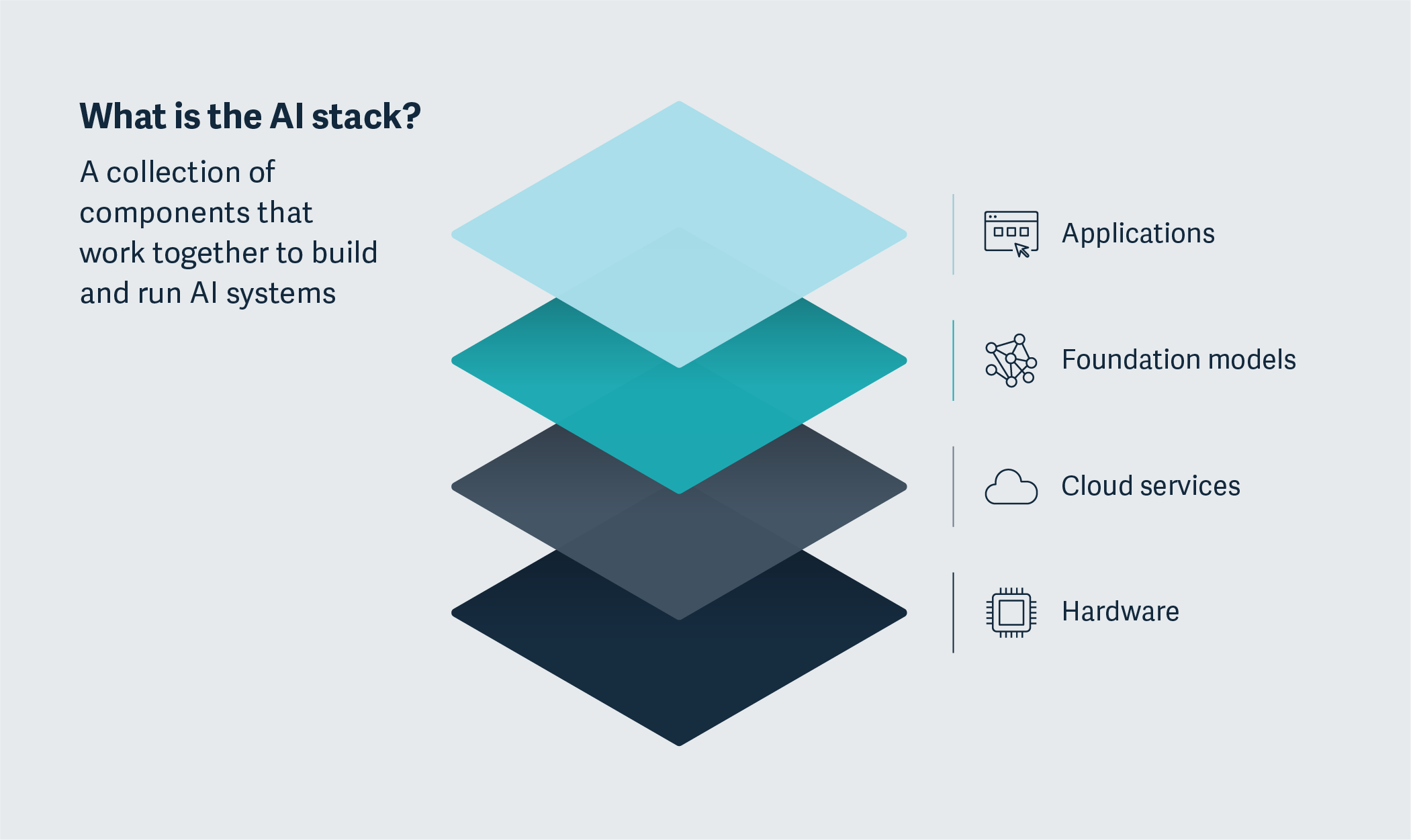
We start with the bottom layer, which is hardware. Think of the chips made by a company like NVIDIA. On top of that we have cloud services, the computing power and software that third-party companies like Amazon Web Services or Google Cloud provide. These services are the basis for the foundation models that operate in the third layer. Those models “do the work.”
Then there is the top application layer. This layer includes the interactions between users and the foundation models, and it is this layer where a lot of economists and competition experts will focus.
What is it about this layer that makes it so interesting to economists?
As a technology economist, I think a lot about network effects, switching costs, and data. Network effects are a phenomenon in which the more a product or service is used, the more valuable it gets. If you think about where some of the most powerful network effects in our digital economy are, they often come from people interacting in an ecosystem. For example, rideshare services like Uber or Lyft. The more drivers there are on the app, the better it is for riders, and vice versa.
I recently conducted research about an attempt to form an ecosystem at this top layer of the AI stack. We were working with a company that wanted to be an AI-forward weight loss app provider. One part of the vision was that AI could be used to create a community. The idea was to use AI to generate the content and personalized support that would usually come from a real life in-person community. Trying to create those interactions artificially backfired; network effects were completely destroyed. A lot of the ways we have used AI thus far have been individualized; it is a siloed experience from the customer end in a way that limits the importance of network effects that have been critical to the analysis of the prior generations of technologies. Network effects may eventually play an important role, but it is not clear that they will, and we may be making an error if we apply competition frameworks rooted in network effects to the AI stack.
And switching costs? How do they impact the competition landscape?
Switching costs are the time, money, and effort it takes to move from a product, brand, or service to another. I was recently listening to the head of the competition bureau of a European country talking about a report they had written, and they were saying that as an economist, you have to have some kind of argument about why there may be a barrier to entry, and they said switching costs. They worked out that it would take 18 months to rewrite the code base once they had gotten attached to a cloud provider. AI is undoing that switching cost as we speak. Coding is commoditized. What used to take 18 months can now be done in hours. It is clear that there is rapid change going on at this level.

Aaron Yeater: Managing Principal, Analysis Group
And then there’s that third element: data?
As competition economists, we know that data are important, but should we worry that data are an essential facility? Data are non-rival. Something that is non-rival can be used by different users for different purposes, at any time, without having to worry about the supply depleting. The data are there for everyone to use.
In the world of AI, we are moving to what we call synthetic data. Synthetic data are artificially generated data created from an actual dataset, but they do not contain identifiable information from the original dataset. If you thought data was ubiquitous before, data are becoming even more ubiquitous now. I am less worried that a single firm or small group of firms will become dominant, exclude rivals, or inhibit market entry. This is another reason that I am optimistic about competition in this top layer of the AI stack.
It sounds like there are plenty of competition questions and AI developments that we should be keeping an eye on.
Let me use an analogy from the early internet age. I feel we are at the ISP stage of the internet. It used to be the case that we were worried about how people got their internet and how internet service providers were going to compete to give people their internet. And then we worried about browsers. We were worried about things such as channels, the idea that drop-down menus would shape our experience and we would have all these switching costs. We got it wrong. Do you notice how that feels a little bit like our conversation today? Remember: We often get these things wrong because it is difficult to predict how consumers are going to want to interact with these new technologies. ■

AG Feature
This feature was published in November 2026.