
-
The Lessons of Experience: Aditi Mehta and Marc Remer on How Their Work at the DOJ Shapes Their Approach to Merger Evaluation
Analysis Group Managing Principal Aditi Mehta and academic affiliate Marc Remer share more than a background in antitrust economics. Both served on the staff of the US Department of Justice (DOJ) Antitrust Division, including working together on some cases. And each of them brings important lessons from that experience to their antitrust work, especially in the realm of merger assessment.
Professor Remer joined the Division as a research economist after completing his Ph.D. at Johns Hopkins University. He spent five years at the agency, focusing largely on evaluating the competitive impact of mergers. Since leaving the DOJ in 2015, he has been on the faculty at Swarthmore College. He has been retained as an expert in a number of merger-related matters.

Marc Remer: Associate Professor of Economics, Swarthmore College
Like Professor Remer, Dr. Mehta joined the Division after her graduate studies, at Boston University. She spent 18 years at the Division. Her last role was as economics director of enforcement, where she oversaw economic analysis across all merger and business-practice investigations. She joined Analysis Group in 2026.
In this Q&A, Professor Remer and Dr. Mehta discuss how their experience gives them a practical sense of how to assess merger effects and how that assessment should unfold.
Dr. Mehta: Marc, you and I both spent significant time at the Antitrust Division. We worked across many industries and saw the various economic issues and tools that can arise across different types of cases. How does that experience shape the way you approach analyzing a merger?
Professor Remer: One thing I took from my experience at the agency is that, when you first start working on a merger case, you’re really just trying to understand how competition works in an industry – how prices are set, how companies are trying to win customers from each other. You don’t focus only on the data, and you don’t confine yourself to a particular model; you're trying to understand how the market works. Those are some of the most interesting and fun parts of the work.
“One thing I took from my experience at the agency is that, when you first start working on a merger case, you’re really just trying to understand how competition works in an industry – how prices are set, how companies are trying to win customers from each other.”– Marc Remer
Dr. Mehta: I agree. The work that happens in the initial stages, when you talk to industry participants and review strategic documents, informs choices about what questions are relevant and what empirical analyses would be most useful. Once you start to understand how the market works, how do you approach modeling?
Professor Remer: A model is, by design, a stylized representation of a market. It needs to capture the fundamental elements of that market, but, by necessity, it also has to abstract away from other market realities. This ties back to what we just talked about – understanding how competition works in the industry. A model should follow from and build on that understanding.
Sometimes there's a tendency for economists to focus exclusively on a particular model and get a prediction from it. But a model is just one aspect of economic analysis – one of many things that economists will do in a case. Just as important is interpreting and analyzing the body of evidence to understand how incentives may change following a transaction.
“[A] model is just one aspect of economic analysis – one of many things that economists will do in a case. Just as important is interpreting and analyzing the body of evidence to understand how incentives may change following a transaction.”– Marc Remer
Dr. Mehta: Interesting economic questions often come up during merger work. How did your work at the DOJ influence the research you’ve subsequently pursued?
Professor Remer: A large chunk of my research really did come out of my work at the Division. One area is improving predictions about how a merger might affect consumers. Another part of my research has to do with merger retrospectives, where you look back at consummated mergers and see if you can measure the extent to which prices or other outcomes have changed as a result of the merger. More generally, I’ve wanted to see if some of the tools that were available in that work could be more useful.
Dr. Mehta: Can you give an example?
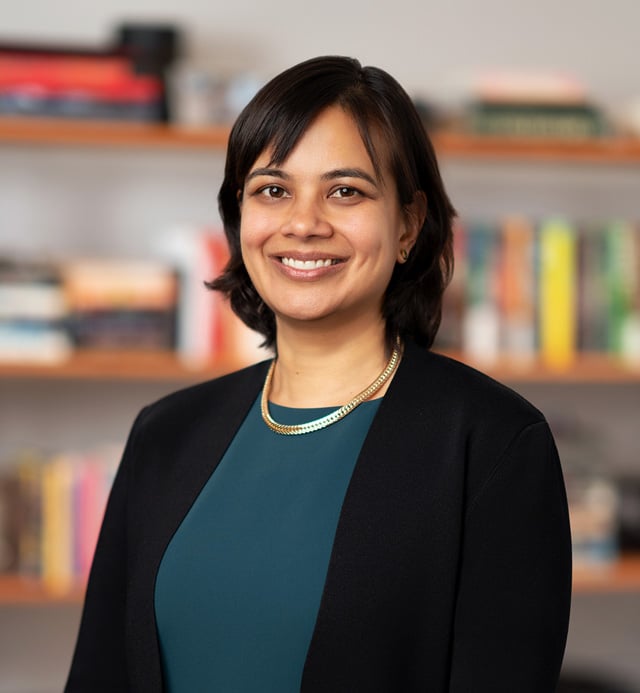
Aditi Mehta: Managing Principal, Analysis Group
Professor Remer: One example is my research on the upward pricing pressure index. In some circumstances, this index can provide information about how prices may change following a merger. When I was at the Division, that index was just starting to be used in case work. And the thinking at that time was that this could be used as a screen when a merger first comes in the door to see whether it might raise competition concerns. Some of my subsequent research has been about whether we can push the usefulness of this index further. Can we actually use it as a predictor of the price effects of mergers? And, if so, under what circumstances? And if you look at the case work now, we're often seeing experts using it as an indicator of how a merger could potentially affect pricing.
Dr. Mehta: You worked on several investigations and litigations while at the Division. In fact, one of my favorite facts about you is that the first merger that you worked on at the Division, H&R Block/TaxAct, went to litigation. Litigation was so rare back then at the Division! What do you think your experience at the DOJ has added to the merger consulting work you’ve done?
Professor Remer: I think it’s given me a good understanding of what the DOJ will be looking at during an investigation, how that investigation proceeds, and the type of analyses they’re likely to find convincing.
I also had a lot of litigation experience while I was at the DOJ, just as you did, Aditi. And I think I took away from it a sense of what type of work can resonate in court.
Dr. Mehta: A unique part of the job at the DOJ was how closely we worked with the attorneys. For the economic analysis to be impactful, we had to make sure that it was communicated effectively to the staff attorneys on the team and the antitrust leadership. Are there similarities with teaching?
Professor Remer: Yes, there’s a lot of overlap with my teaching career. One of the most important skills an expert brings is that you're simplifying complicated topics and telling the story of the case to either a judge or jury. Similarly, my job now is explaining antitrust topics to an audience of very smart people.
Dr. Mehta: Generally, what I love most about antitrust work is that each case feels unique, with different fact patterns, different economic issues, and different potential approaches, so it always feels interesting. What keeps it engaging for you?
Professor Remer: I like trying to solve economic problems, I like working in a collaborative environment with other like-minded people, I like teaching, and I like using my skills and training to make contributions. Research, teaching, and expert work give me the opportunity to do all of this, and they complement each other. That keeps things interesting for me, as well as professionally and personally rewarding.

AG Feature
This feature was published in June 2026.